Bookshelf Styling That Still Leaves Room for Books
Styled shelves that forget the books are just storage with better PR. The two-thirds formula, the triangle trick, and how to keep it working after week one.
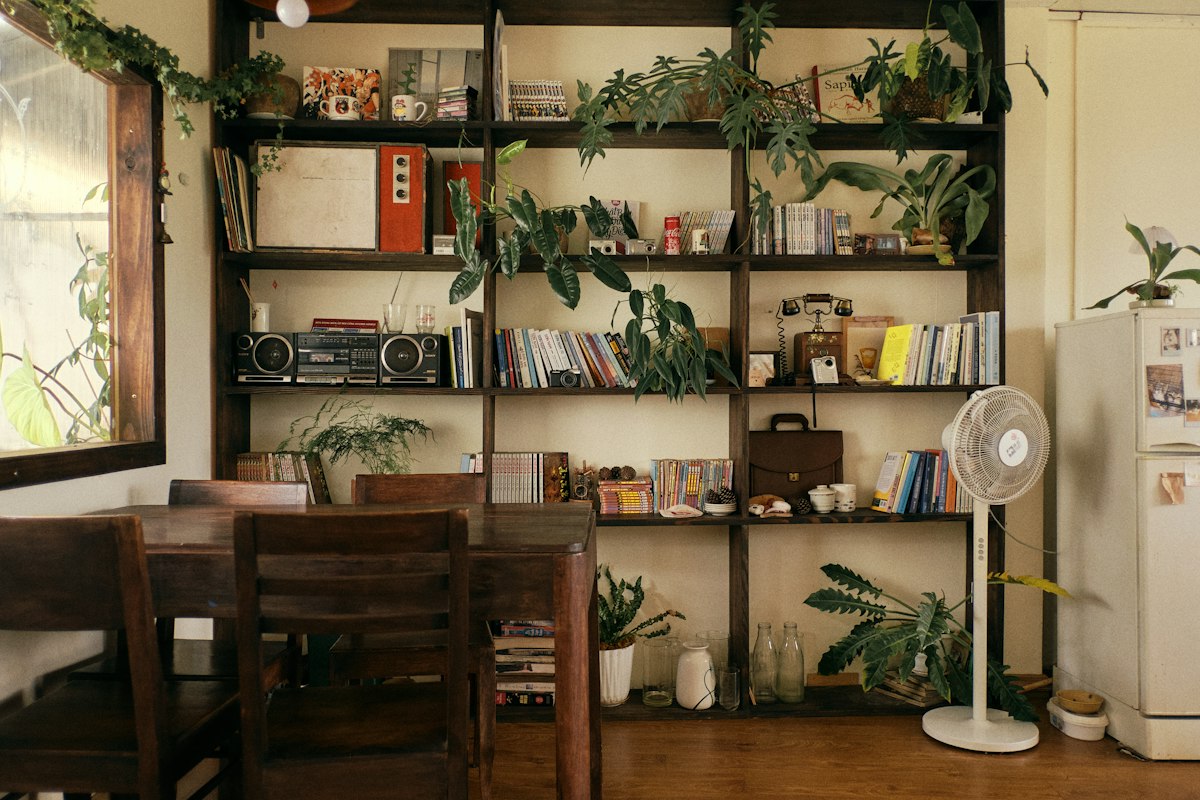
Somewhere between the third styling video and the fifth ceramic vase, a quiet suspicion arrives: this bookshelf is supposed to hold books. Styled shelves look effortless in photos — a leaning stack here, a plant trailing there — but real shelves have jobs. They hold the novels you'll reread, the board games, the chargers, and the one drawer-less household's worth of small homeless objects.
The good news is that styling and storage aren't enemies. The shelves that work in real homes follow a simple logic: books get the majority, objects get the supporting roles, and every shelf leaves a little air so the eye can rest. It's a formula, not a talent.
Here's the approach that keeps a bookcase beautiful on Sunday and useful on Tuesday — plus the shelf math that makes books the feature instead of the obstacle.
The short version
Give books roughly two-thirds of your shelf space and objects one-third, distributed so no single shelf is all of one thing. Group books in a mix of vertical rows and short horizontal stacks (which double as bookends and display surfaces), leave 20–30 percent of each styled shelf empty, and repeat two or three materials — say, wood, ceramic, and one metal — across the whole bookcase. That rhythm is what reads as "styled," and it costs nothing.
What to look for
- Adjustable shelves. Book heights vary wildly; fixed shelves waste vertical inches. Workhorses like IKEA's BILLY have adjustable shelves for a reason — set shelf gaps to the books, not the factory default.
- Depth of 10–12 inches. Deeper shelves swallow paperbacks and create a dark cave behind the front row. Standard bookcase depth (BILLY is about 11 inches) keeps spines near the light.
- A few closed sections. Doors or boxes on the lowest shelves hide the genuinely ugly necessities — cables, games with broken boxes, the printer paper. Open shelves for beauty, closed for honesty.
- Bookends with actual weight. A styling stack works, but for long rows, weighted bookends (stone, cast metal, or a heavy ceramic) keep the lean from becoming a slide.
- One lighting plan. A small picture light, a strip of LEDs, or a lamp on the top shelf turns a bookcase into the room's warmest corner after dark — see our lamp comparison for shelf-friendly options.
BILLY Bookcase
The best-selling bookcase in the world for good reason: adjustable shelves, an 11-inch depth that keeps spines near the light, and optional doors for the shelves that need to hide things.
- Adjustable shelves fit real book heights
- Optional glass or panel doors
- Multiple widths that combine seamlessly
- + Unbeatable price per shelf
- + Grows with your collection
- – Particleboard — respect the weight limits
- – Plain without styling effort
KALLAX Shelf Unit
The cube grid that styles itself: each cubby becomes its own vignette of books, baskets, or a plant, and the unit works standing, lying on its side, or as a room divider.
- Cube grid suits mixed storage
- Works vertically or horizontally
- Wide range of insert boxes and doors
- + Forgiving for styling beginners
- + Doubles as a room divider
- – Cubes are too small for oversized art books
- – Deep cubes can swallow paperbacks
Conceal Floating Bookshelf
A small steel shelf that disappears under a stack of books, making them appear to float on the wall — the styling trick guests always ask about, and real storage for a short stack.
- Hidden bracket creates a floating effect
- Holds a stack of books per shelf
- Powder-coated steel construction
- + Genuine visual magic for little money
- + Great for small walls and corners
- – Limited capacity per shelf
- – Requires solid wall mounting
The styling formula, shelf by shelf
Start empty. Yes, really. Take everything off, group books by size (and, if you can stand it, roughly by color family within size), and put back only what you'd be sad to store elsewhere. The donation pile is the first styling tool.
Anchor each shelf with books. A vertical run of books occupying about half the shelf, stopped by a horizontal stack of two or three larger books, is the core move. The stack's top surface becomes a stage for one object — a small plant, a framed photo, a bowl. One object. The stage is small on purpose.
Work in triangles. Across the whole bookcase, place your eye-catching objects (the plant, the brass thing, the colorful vase) at the points of loose triangles rather than in a row or a column. The eye travels between them and perceives a composition instead of a lineup.
Vary heights within a shelf, repeat materials across shelves. Tall vase beside short stack beside medium row of books. Then, three shelves down, another ceramic piece and another touch of the same wood tone. Repetition is what separates "styled" from "stuff on shelves."
Leave air. The most common amateur mistake is filling every inch. A shelf that's 70 percent full looks generous; 100 percent looks like storage. If you own more books than the case holds gracefully, congratulations — you need a second case or a stricter edit, not tighter packing.
A practical note for real collections: keep the books you reach for at waist-to-eye height, and exile the oversized atlases and archives to the bottom shelf, where their weight also stabilizes the case. Cube systems like IKEA's KALLAX suit this well since each cube becomes its own vignette — one cube of books, one with a basket, one with a plant, and the grid does the composing for you.
Keeping it styled after week one
The formula survives daily life if you give new arrivals a rule: a book joins the shelf only when it fits an existing run, and objects don't migrate. Dust monthly with the books in place (a soft brush along the tops works), and do a five-minute re-edit each season — shelves drift slowly, and small corrections prevent the annual total teardown. If your shelves double as a room divider, our entryway guide shows how a bookcase can split spaces without blocking light.
The 60-second test: stand across the room and squint. You should see rhythm — dark and light blocks alternating, a few bright accents, no shelf noticeably fuller than its neighbors. If one shelf screams, it's overpacked.
FAQ
What percentage of a bookshelf should be books?
Around two-thirds books to one-third objects and empty space is the balance most real homes can maintain. Avid readers can push to 80 percent books if the rows are tidy and broken up with occasional horizontal stacks; below half books, it stops reading as a bookshelf at all.
Should books be organized by color?
By color looks striking in photos and maddening in practice if you hunt by author or subject. A workable middle ground: group by size first (it makes rows look intentional), keep series together, and let color blocks happen naturally within shelves rather than across the whole case.
How do I style shelves around a TV or in a working bookcase?
Style the shelves furthest from the action and keep the grab-and-go shelves purely functional — a clear cookbook row in a kitchen-adjacent case is its own kind of styling. Symmetry around a TV (matching stacks on both sides) calms the electronics' visual noise.
What can I use as bookends from things I already own?
Heavy, stable, flat-sided objects: a stone or marble offcut, a filled ceramic vase, a stack of large art books laid horizontally, a cast-iron anything. If it can't hold a row of hardcovers against a firm nudge, it's decoration standing near books, not a bookend.